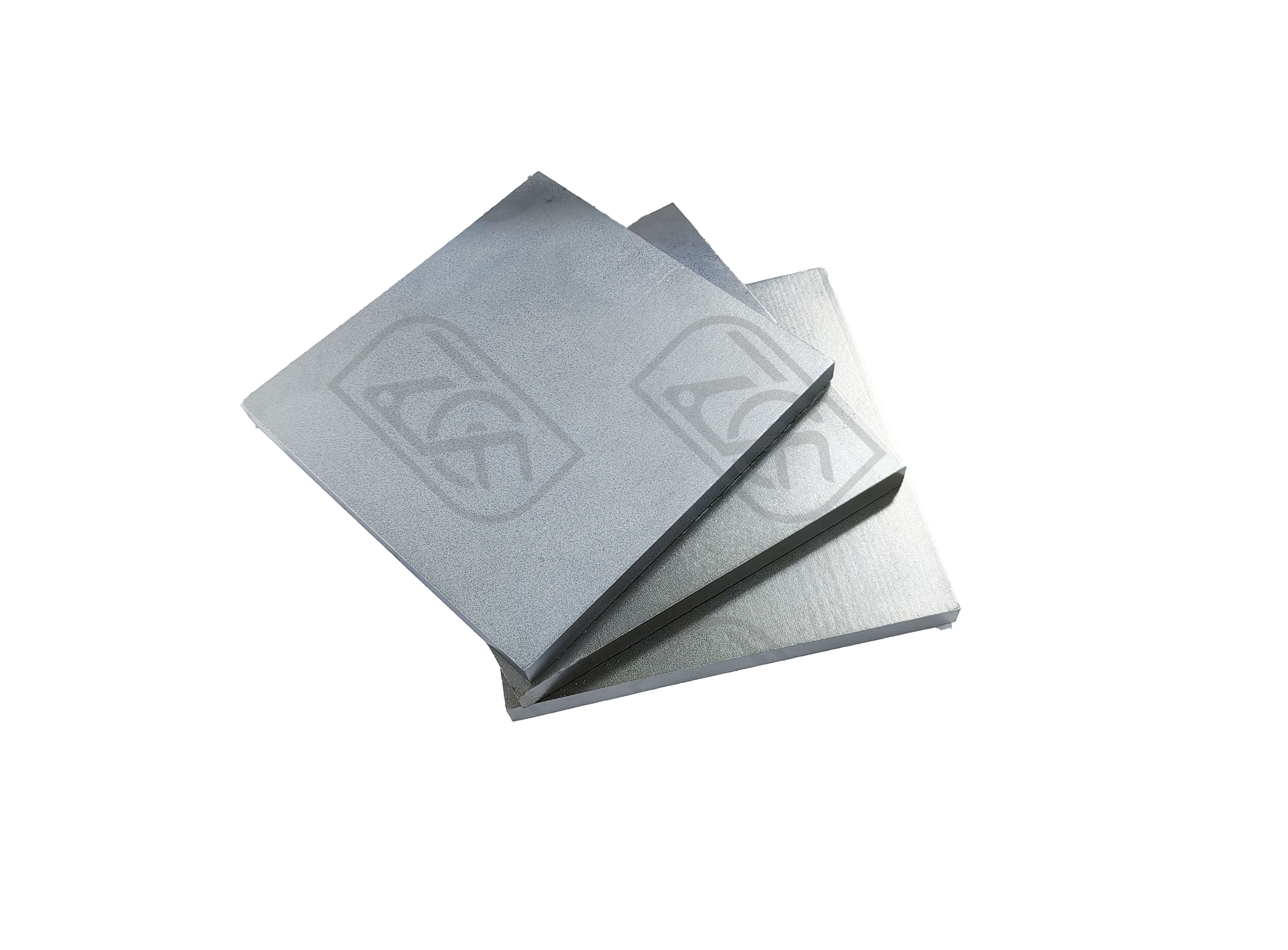
Tungsten carbide (cemented carbide) is produced by powder metallurgy sintering, using tungsten carbide as the hard phase and cobalt or nickel as the binder phase. Its Vickers hardness is typically in the range of 5,000–8,000 HV, its elastic modulus is much higher than that of ordinary steel, and its transverse rupture strength can reach 1.8–2.5 GPa. It also retains considerable hardness and rigidity at elevated temperatures. These properties make tungsten carbide the material of choice for dies, cutting tools and wear parts, but they also make it a difficult material to machine from the moment it leaves the sintering furnace. The extreme equipment requirements for tungsten carbide machining are not a vague industry complaint; they are hard constraints determined by its physical and mechanical properties, material removal mechanisms, thermo-mechanical coupling behavior and accuracy retention requirements.
1. Hardness Combined with Brittleness: Rigidity Is a Prerequisite, Not an Option
The hardness of tungsten carbide makes it difficult to remove effectively by conventional cutting. In current industrial practice, the main routes for direct machining of cemented carbide remain grinding and EDM, and neither process is characterized by high removal rates. More critically, tungsten carbide combines high hardness with limited fracture toughness, imposing stringent requirements on the dynamic characteristics of machine tools.
In micro-milling or grinding, insufficient structural rigidity or poor damping characteristics can cause cutting force fluctuations and spindle vibration—enough to initiate microcracks on the machined surface or even cause edge chipping. In tungsten carbide machining, tool-workpiece contact is not conventional “cutting”; it is closer to a critical competition between brittle fracture and plastic removal under high local pressure. To keep material removal stably within the plastic or ductile regime, the machine tool must have both high static and dynamic stiffness, together with a high-resolution, low-friction feed system. Aerostatic spindles and linear motor drives are repeatedly specified for precision cemented carbide machining precisely because they provide motion smoothness that conventional ball screws and mechanical bearings cannot achieve, keeping each depth of cut below the brittle-to-ductile transition threshold.
2. Thermal Management Determines Success: High Temperature in the Grinding Zone Is an “Invisible Tool”
Although tungsten carbide has a relatively high thermal conductivity, energy in grinding and EDM is highly concentrated in a small contact zone. Heat cannot conduct quickly into the bulk of the workpiece and therefore accumulates rapidly at the surface. The instantaneous temperature in the grinding zone can cause phase transformation or oxidation of the cobalt binder, resulting in grinding burn; local thermal stress directly initiates microcracks, and in severe cases can cause an entire batch to fail prematurely in service.
Therefore, one of the core capabilities of tungsten carbide machining equipment is the systematic level of thermal management. Coolant type, pressure, flow rate and injection position must be designed in coordination with the process cycle: strongly alkaline coolants are prohibited in cemented carbide grinding to prevent cobalt leaching and corrosion; effective cooling requires the coolant to penetrate precisely into the grinding wheel–workpiece contact arc, not merely to be “poured onto the workpiece.” In higher-end configurations, coolant oil temperature must be actively controlled within a narrow range, and pump pressure and cooling method must be upgraded accordingly, so that grinding heat is removed at the source rather than remedied afterward. This means that thermal stability is reflected not only in thermal symmetry of the machine bed and ambient temperature control, but also in the overall coupling of spindle cooling, coolant temperature control, filtration and injection systems. A machine tool that performs adequately in ordinary steel machining will quickly expose its thermal management shortcomings in tungsten carbide grinding as burn, cracks and profile distortion.
Typical tungsten carbide components—precision mold cavities and cutting edges, tool cutting edges, and mating surfaces of wear parts—often require dimensional and form accuracy in the micron or even sub-micron range. Surface roughness requirements for high-precision tools can be below Ra 0.1 μm, and geometric errors of complex profiles must be controlled at the 0.01 mm level or tighter. At this level, the challenge is no longer whether the machine can reach the required position, but whether it can consistently do so over long machining cycles.
The high hardness of tungsten carbide means that tool or grinding wheel wear during machining is much faster than with conventional materials, and the resulting dimensional drift must be compensated in real time within the process strategy. At the same time, thermal elongation of the machine tool, guideway wear and servo response lag all accumulate as non-negligible error sources at the micron scale. Therefore, equipment for precision tungsten carbide machining usually needs integrated online measurement or rapid on-machine inspection capability, forming a closed loop with offline high-precision inspection methods such as coordinate measuring machines (CMMs). A CMM can achieve volumetric accuracy at the micron level and can resolve form errors of complex surfaces and special-shaped parts, but if the machining equipment itself lacks sufficient accuracy retention, inspection can only “screen out rejects” rather than “control the process.” The value of the equipment lies in turning accuracy from “measurable” into “repeatable.”
When discussing equipment requirements for tungsten carbide machining, one easily overlooked dimension is the consistency of the workpiece material itself. For the same grade of tungsten carbide, if grain size and cobalt content fluctuate from batch to batch, its grindability, EDM discharge stability and sensitivity threshold to grinding heat will also drift. If equipment parameters cannot be stably matched to material characteristics, even the most advanced machine tool will struggle to deliver consistent yield.
This is where the hidden value of material-side technical accumulation lies. For example, ZCCF Tungsten Carbide controls grain size below 0.2 μm in the ultra-fine grain tungsten carbide field, with hardness reaching HRA ≥ 92, and has established a full-process quality control system covering spectral analysis and metallographic inspection from raw material screening to finished product inspection. Even more noteworthy is batch stability control: the company’s published batch-to-batch variation is less than 0.5%, which in tungsten carbide machining means that downstream equipment faces a “predictable material input.” When thermal properties, hardness and microstructure are highly consistent from batch to batch, grinding parameters, EDM pulse conditions and cooling strategies can have a repeatable process window; the high rigidity, high precision and thermal management capability of the equipment can then truly translate into stable machining quality and efficiency. ZCCF Tungsten Carbide has been deeply engaged for 30 years in precision forming fields such as cold heading, hot forging and powder metallurgy, and its material hardness, wear resistance and stability continue to lead in the industry, with product life 30–50% longer than the industry average. Behind these figures, material-side uniformity control is in effect “reducing the burden” on downstream machining equipment.
In this sense, the extreme equipment requirements for tungsten carbide machining are not only a test of machine tool manufacturing capability, but also a test of material consistency across the upstream supply chain. A machine tool with high rigidity and high thermal stability, when paired with tungsten carbide blanks that fluctuate significantly from batch to batch, will have its accuracy retention and process window eroded by material unpredictability. Only when the material side controls grain size, cobalt content and sintered microstructure within a narrow distribution can the equipment side convert “limit performance” into “daily yield.”
The equipment requirements for tungsten carbide machining are essentially a systemic issue: rigidity determines whether the material can be “cut without fracturing,” thermal management determines whether it can be “machined without damage,” accuracy retention and inspection loop determine whether it can be “machined accurately and repeatably,” and material consistency determines whether these capabilities can be consistently delivered from batch to batch. If any one of these four is missing, tungsten carbide machining degenerates into a costly battle dependent on empirical fixes. Suppliers that deepen uniformity control at the material source do not manufacture machine tools directly, but they effectively define the upper limit of downstream equipment performance. The material capability built by ZCCF Tungsten Carbide on the basis of ultra-fine grain control and batch stability is a typical footnote to this logic in the upstream supply chain: when the tungsten carbide material itself is sufficiently “predictable,” the high equipment requirements do not become an excessive burden.
(+86)18962368366
(+86)18962328299
ping.wu@cszccarbide.com
yan.feng@@cszccarbide.com
No.4 Xiaoshanjing Road, Zhitang Town, Changshu City, Jiangsu Province, China